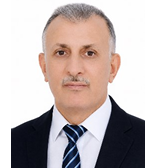
Professor Abdullah Hamoud Abdullah Al-Saadoun is a specialist in the life sciences, with a specific current focus on mycology. He obtained his Master’s degree from the University of Basrah in 1989 for his thesis titled:
*A Study on the Fungus Mauginiella scattae Cav., the Cause of Inflorescence Rot Disease in Date Palm Trees.*
He has worked in both academic and administrative capacities, having served as the Assistant Dean for Scientific Affairs at the College of Health and Medical Technologies. He currently holds the position of Head of the Pathological Analysis Sciences Department at the College of Science, Shatt Al-Arab University.
He holds two patents in the fields of microbiology and mycology: the first involves the production of an antibiotic using two types of yeast, while the second addresses the laboratory production of carotenoids—acting as antifungal agents—using two strains of pigmented yeast.
He has published numerous scientific papers in reputable international journals. His research focuses on medical and environmental fungi, antifungal resistance, genes associated with drug resistance, and endophytic fungi that produce bioactive compounds. Additionally, his work covers the biosynthesis of nanoparticles and the study of their antifungal and anti-cancer activities.
He has participated in various local and international scientific conferences and exhibitions, including the International Invention Fair in the Middle East (Kuwait) and exhibitions showcasing patents and scientific outputs in Iraq. He has also received gold, silver, and bronze medals in recognition of his excellence in scientific invention and innovation.
He was named "Top Professor" at the College of Science, University of Basrah, for the 2022–2023 academic year, in recognition of his outstanding scientific and academic achievements. He has supervised the theses and dissertations of 19 graduate students—comprising 15 master's theses and 4 doctoral dissertations—and has taught various academic courses, including biology and radiobiology.
His current research interests focus on the study of medical and environmental fungi, the identification of genes responsible for antifungal resistance, and the utilization of fungi and yeasts to produce bioactive compounds and antifungal agents. Additionally, he works on the biosynthesis of nanoparticles and the study of their medical and therapeutic applications.
A- Academic Duties:
1. Achieving the university's high-level goals and policies.
2. Implementing College Council decisions regarding the department.
3. Overseeing the preparation of the department's strategic plan and monitoring its implementation.
4. Managing the department's educational, research, administrative, financial, and cultural affairs.
5. Overseeing the administrative, academic, and research development of the department.
6. Fulfilling the assigned teaching load for each semester.
7. Monitoring student attendance and conducting examinations for theoretical and practical courses.
8. Coordinating and developing the department's relationships both within and outside the university.
9. Overseeing the provision of the department's educational, research, administrative, and financial requirements.
10. Overseeing quality enhancement and the improvement of outcomes.
11. Implementing and following up on Department Council decisions.
12. Exercising powers delegated by the College Dean.
13. Reporting to the College Dean any failure by faculty members (or equivalent staff) to fulfill required duties or any other violations.
14. Conducting periodic reviews and evaluations to develop the department's scientific and academic curricula and presenting them to the College Council.
15. Hosting external lecturers to deliver talks on specific topics to undergraduate and postgraduate students.
16. Overseeing the conduct of instruction, teaching methods, and the performance of duties by faculty members.
17. Preparing quarterly and annual scientific reports on the department's activities.
18. Submitting research papers to scientific committees for endorsement and promotion purposes.
19. Assigning students to training sites, allocating supervision duties among department staff, and issuing the necessary administrative orders. 20. Proposing the issuance of administrative orders regarding full-time academic status and additional lectures based on actual need and in accordance with prevailing university regulations, following the approval of the College Council.
21. Overseeing the academic affairs of students across all study levels.
22. Proposing experts to review academic promotions for the department's faculty members.
23. Assigning teaching duties to faculty members as needed, regardless of limits set by higher authorities.
24. Approving faculty members to deliver lectures within the academic or training programs of other departments.
25. Approving the nomination of faculty members to participate in technical, administrative, and academic committees.
26. Addressing inquiries to faculty members regarding absences or delays in attending lectures and holding them accountable.
27. Chairing the department's academic committee.
28. Liaising with academic departments within the university, corresponding departments in other Iraqi universities, and the Technical Education Commission regarding academic and teaching matters—or the selection of lecturers and securing necessary approvals to utilize their services—provided the College Deanship is informed.
29. Issuing necessary administrative orders regarding the department's academic affairs after obtaining Deanship approval, in accordance with established academic authority.
30. Determining the department's requirements for faculty, technical staff, and administrative personnel.
31. Proposing student intake numbers and criteria for the academic department based on its admission capacity.
32. Recommending the approval of final results for the department's students and monitoring students regarding all aspects of their academic progress.
33. Allocating courses among the faculty members of the academic department. 34. Preparing the department’s course and examination schedules and communicating them to the College Dean’s Office.
35. Holding meetings with department students (at least once per semester) to assess their needs, identify challenges and difficulties encountered during their academic journey, listen to their suggestions and opinions, devise necessary solutions, and submit recommendations to the College Dean if required.
36. Preparing job performance evaluation reports for faculty members and administrative staff within the department and submitting them to the College Dean.
37. Supervising the academic advising process within the department and assigning students to faculty members.
38. Conducting course equivalency assessments for students transferring from other majors or universities (academic credit transfer).
39. Reviewing excuses submitted by students for absences from lectures or examinations.
40. Supervising laboratory operations, ensuring equipment functionality, and addressing any shortages.
B - Administrative Tasks:
1. Signing the annual increment and promotion forms—in the capacity of direct supervisor—for all department personnel, and recommending the granting of such increments and promotions.
2. Approving the granting of standard leave entitlements to university service staff—as stipulated in Article 9, Paragraph (A) of the University Service Law No. 142 of 1976—for use within the country, subject to the provisions of Paragraph (1) of the aforementioned Article.
3. Approving the granting of accumulated standard leave to university service staff (department or branch personnel)—accrued from service outside the teaching cadre, if applicable—in accordance with the University Service Law and provided it does not conflict with work requirements. 4. Recommending the issuance of letters of appreciation and commendation to department or branch staff—as well as external personnel—in recognition of outstanding performance.
5. Assigning duties to department or branch staff in accordance with the department's academic interests and issuing the necessary administrative orders.
6. Convening the department council for extraordinary sessions when necessary.
7. Recommending dismissal decisions for students who exceed the permitted absence limit, in accordance with applicable regulations.
8. Issuing administrative orders regarding warnings and course failure due to excessive absences, negligence, or violations of regulations and instructions.
9. Issuing administrative orders for the delivery of lectures by staff or external lecturers (in coordination with the College Dean's Office); establishing and verifying relevant records or forms against issued orders; and overseeing payment processing through the department secretariat in coordination with the College’s Finance Department.